Verifiable Data in Onchain Finance: Chronicle’s Proof of Asset Full Service Design
/ 3 min read
Modern finance is still reacting to a series of trust failures. From global financial crises to high-profile crypto collapses, the recurring lesson is not simply that risk was mispriced, but that information was incomplete, delayed, or impossible to verify independently. Institutions, regulators, and market participants were forced to rely on representations that could not be confirmed in real time. In response, verifiability has become a core requirement rather than a secondary reporting concern. Investors want evidence that assets exist. Policy makers want better visibility into exposures. Protocol designers want inputs that can be validated deterministically. Financial engineers want systems that can be audited by machines, not only by people. What has changed is the expectation that transparency should be continuous and cryptographically enforceable. Periodic disclosure is hard to reconcile with markets that run 24/7, settle quickly, and increasingly span onchain and offchain environments.
The Convergence of DeFi and TradFi
The convergence of decentralized finance and traditional finance is often described in terms of tokenization, settlement speed, or distribution efficiency. These are important outcomes, but they are downstream effects. The deeper challenge sits at the trust boundary between systems that are natively verifiable and systems that were never designed to expose their internal state continuously. DeFi assumes verification is continuous and composable. Smart contracts expect data that can be consumed automatically and validated deterministically. TradFi, by contrast, is built on intermediated trust. Custodians, fund administrators, auditors, and regulators all play distinct roles, with information flowing through structured but slower channels. Bridging this gap requires more than better reporting. It requires a verification primitive that can operate across institutional infrastructure and onchain systems without turning reporting artifacts into the source of truth.
Proof of Asset in Contrast to Existing Verification Frameworks
Over the past several years, the industry has introduced mechanisms designed to improve transparency around backing and solvency. While these efforts represent meaningful progress, many are optimized for issuer-centric reporting and offer limited visibility into the underlying assets. As tokenized assets get integrated into onchain finnace, verification systems must support continuous, source-level assurance. Chronicle’s Proof of Asset is designed for this environment.
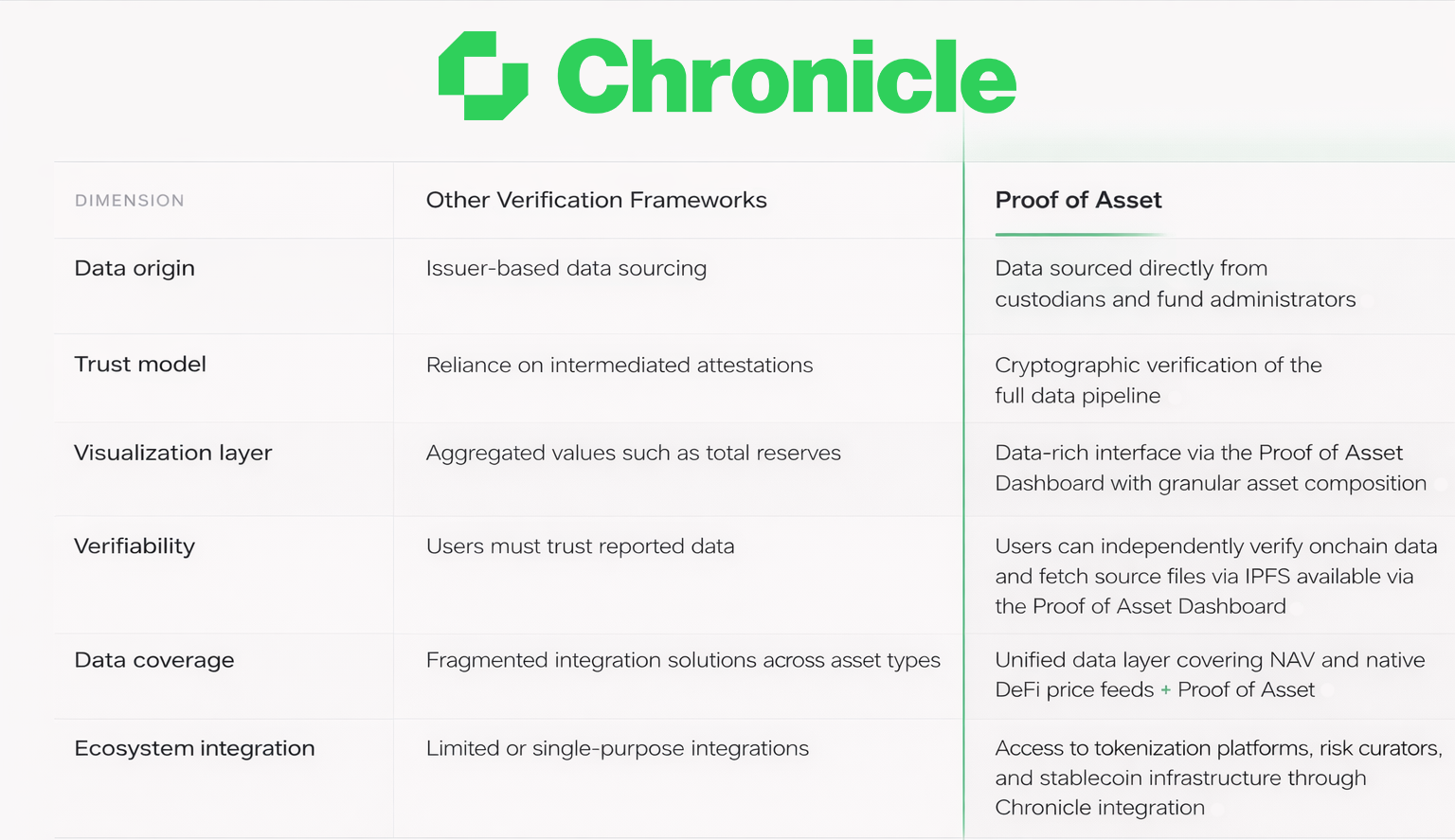
Most verification systems rely on issuer-based data sourcing. Asset information is provided by the entity issuing the tokenized product, often as summarized disclosures that are then relayed onchain. Proof of Asset instead connects directly to custodians and fund administrators, anchoring assurance at the system of record rather than at the issuer layer. That shift changes the trust model. Instead of relying primarily on intermediated attestations, Proof of Asset applies cryptographic verification to the full data pipeline, so observers can validate both the reported figures and the integrity of how those figures were produced. The distinction is also visible in how information is presented. Existing solutions typically expose aggregated values such as total reserves, which can be useful as a headline but offer limited insight into composition. Proof of Asset provides a data-rich visualization layer through the Proof of Asset Dashboard, enabling granular views into underlying assets and their composition. Verifiability then shifts from an assumption to an explicit fact. In many systems, users are forced to accept oracle outputs as final. With Proof of Asset, Chronicle allows anyone to use the Proof of Asset Dashboard to independently check onchain data and confirm it matches the original source, making any potential change immediately detectable.
Proof of Asset also differs in scope. Rather than offering fragmented tools across asset types, Chronicle provides a unified data layer that supports pricing for tokenized assets alongside native DeFi price feeds. This allows protocols and institutions to rely on one data stack across hybrid financial systems, instead of stitching together separate pipelines for verification and market data. Ecosystem integration follows directly from that unified data layer. By integrating with Chronicle’s data pipeline, issuers and protocols can leverage a network of tokenization platforms, risk curators, and stablecoin infrastructure to bring tokenized assets into DeFi markets. One such example is the ACRDX/USDC market curated by Steakhouse on Morpho. ACRDX is a tokenized fund issued via Centrifuge and verified through Chronicle’s Proof of Asset framework, with the strategy led by Anemoy Capital. The fund provides exposure to a diversified portfolio of private credit investments via the Apollo Diversified Credit Fund, managed by teams at Apollo Global Management. In this setup, verification and pricing are handled through Chronicle’s unified data layer, simplifying integration into an onchain lending market. Together, these differences position Proof of Asset not as a reporting mechanism, but as verification infrastructure suited to hybrid onchain and offchain financial systems.